As this blog is about a journey (with side trips) learning to long arm quilt, this celebrates this learning. I just finished a quilt for a friend and fellow quilter. The challenge was that the quilt had a lot of black but also jewel like patches. What colour to quilt and the back was a dark red with a black design. All black? All light beige or cream? Neither option was a good one. So I took the plunge and did two colours. The bobbin was consistently black but the top thread was changed from black to a golden beige. It worked. Much checking with each roll to see that the tension stayed constant hiding the reverse colours on both sides of the quilt. It turned out. As it is not my quilt there is no picture but I am truly pleased and so is the owner.
The additional advantage of doing the two colours was to solve the problem of receiving quilts for which you have no additional practice to set the tension. Well problem solved. Put a contrasting thread in the bobbin, really contrasting, and test stitch a bit and get the tension right. Then a couple of minutes of picking out the stitches and problem solved.
Learning happens in so many ways. I just found the actual manufacturer of my robot and the robot software. The YouTube videos for Butler are fantastic as is their service to my questions. The manuals that came with my machine have pictures but the videos and accompanying explanations spoken are wonderful.
I consider this my present leading up to Christmas. Research something you cannot understand and you do not know what you will find. Of course this is only two or three steps in a learning journey.
Showing posts with label learning. Show all posts
Showing posts with label learning. Show all posts
Wednesday, 10 December 2014

Thursday, 27 November 2014
Discovery
One thing about long arm quilting, there is never a time when you are not learning. Each quilt talks to you; really. What you do in one part of quilt can help you understand what other parts want. The variables are numerous; the quilt style, the quality of the fabrics, the piecing skill of the maker and the final use of the quilt along with the batting. And of course there are the many varied threads and embellishments that can add interest and effect.
A big challenge doing a quilt is to get the tension right. Although I have tools for this, they are just markers like on a race marked at various points but exactly how each runner will take time to get between markers is different and so tension varies with fabric, batting, how tight the quilt is rolled and the workmanship of the piecer. So how do you test the tension on a quilt someone else has made when there is no extra fabric? Well here is how I have discovered works best after trying several ways. Put a different thread in the bobbin; preferably a contrasting as possible. Right now I am doing a quilt that has black and colours and the black is too black for the colours and the light thread is too light for the black. This lead me to try to gauge the tension but using the light colour in the bobbin. It worked. On both sides you can clearly see if there are 'pokies' i.e. stitches of the opposite colour poking through. A few wavy lines and you can see how the tension is doing. Curved lines behave a bit different when being stitched and show more quickly if tension is not right; those pesky pulls on the top tension showing on the back. It is then simple to snip out the test stitches.
But what this allowed me to do on this quilt because the back is quite dark is to do the whole back in the black thread and parts of the front in black and parts in the light thread. What fun to see it happening. Often quilts have highly contrasting areas, especially panels which are fun to add trapunto to or to quilt in various stitches to give the panel a 3 dimensional effect. I have often mused in my head about the ability to use contrasting threads on the front and back and now I can. It means carefully testing at the beginning of each roll of the quilt to ensure you are still maintaining the same tension as this tension on the quilt from the rollers can vary with the day and the weather and how tight you think it is. A bounce test with the hands does have some limitations.
So, learning is a daily joy. So is having fun doing something you love.
Keep warm and dry on this nor'easter day which is wet, wet, wet in the Annapolis Valley.
A big challenge doing a quilt is to get the tension right. Although I have tools for this, they are just markers like on a race marked at various points but exactly how each runner will take time to get between markers is different and so tension varies with fabric, batting, how tight the quilt is rolled and the workmanship of the piecer. So how do you test the tension on a quilt someone else has made when there is no extra fabric? Well here is how I have discovered works best after trying several ways. Put a different thread in the bobbin; preferably a contrasting as possible. Right now I am doing a quilt that has black and colours and the black is too black for the colours and the light thread is too light for the black. This lead me to try to gauge the tension but using the light colour in the bobbin. It worked. On both sides you can clearly see if there are 'pokies' i.e. stitches of the opposite colour poking through. A few wavy lines and you can see how the tension is doing. Curved lines behave a bit different when being stitched and show more quickly if tension is not right; those pesky pulls on the top tension showing on the back. It is then simple to snip out the test stitches.
But what this allowed me to do on this quilt because the back is quite dark is to do the whole back in the black thread and parts of the front in black and parts in the light thread. What fun to see it happening. Often quilts have highly contrasting areas, especially panels which are fun to add trapunto to or to quilt in various stitches to give the panel a 3 dimensional effect. I have often mused in my head about the ability to use contrasting threads on the front and back and now I can. It means carefully testing at the beginning of each roll of the quilt to ensure you are still maintaining the same tension as this tension on the quilt from the rollers can vary with the day and the weather and how tight you think it is. A bounce test with the hands does have some limitations.
So, learning is a daily joy. So is having fun doing something you love.
Keep warm and dry on this nor'easter day which is wet, wet, wet in the Annapolis Valley.
Tuesday, 9 September 2014
Talking to Oneself
I started this blog because I was learning to quilt with a long arm. Of course in learning there were mishaps so thinking my laughing at myself might help someone as I have been helped this blog came into being. This help with learning I have received has been through listening to, watching or reading about someone else.
Some things have been conquered but not everything so today was a 'talk to self day'. Part of this was brought on by seeing work done by more experienced quilters at one of the guilds I belong to, Mahone Bay Quilters. I came home in a funk. I can never be that good or productive was my mental topic all the way home. So this morning after a couple of cups of coffee after a late night, I started my conversation with myself.
Not all of it is here but let me say it was what could be called a bracing talk. It has resulted in some boxes being moved from their stodgy places and a 'plan' for the day.
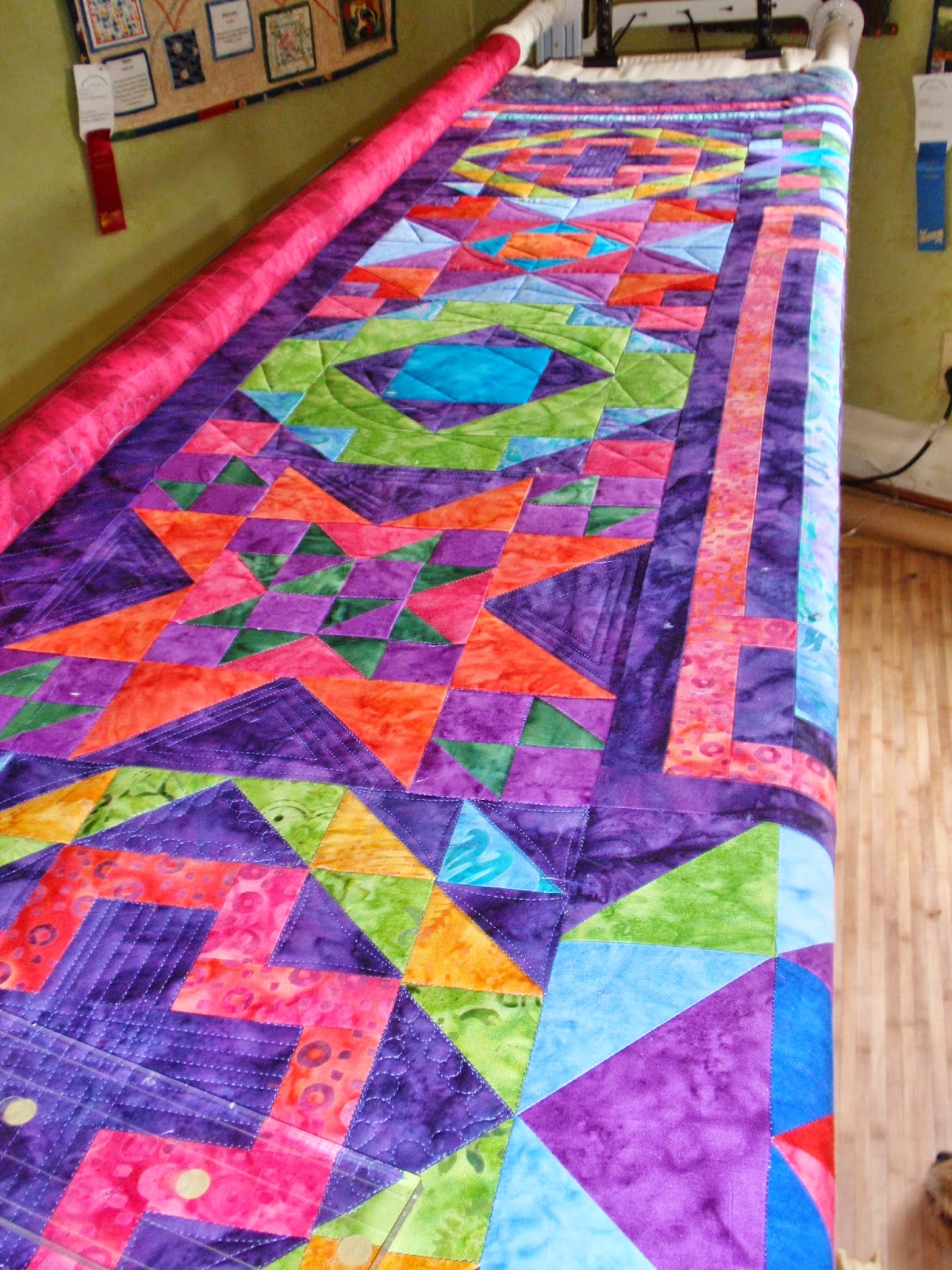
As it relates to quilting, part of the plan was to get in an hour on my Celtic Quilt which has finally reached the frame. Every block but 4 are different, no one colour predominates, and it was the quilt which really taught me about accurate piecing. But that is another topic. I cannot undo what I have done but fortunately the many bright colours stop the eyes from finding too many mistakes or should I say learning opportunities.
So here are a couple of things you have probably experienced.
1. Stitching outside the ditch.



Some things have been conquered but not everything so today was a 'talk to self day'. Part of this was brought on by seeing work done by more experienced quilters at one of the guilds I belong to, Mahone Bay Quilters. I came home in a funk. I can never be that good or productive was my mental topic all the way home. So this morning after a couple of cups of coffee after a late night, I started my conversation with myself.
Not all of it is here but let me say it was what could be called a bracing talk. It has resulted in some boxes being moved from their stodgy places and a 'plan' for the day.
As it relates to quilting, part of the plan was to get in an hour on my Celtic Quilt which has finally reached the frame. Every block but 4 are different, no one colour predominates, and it was the quilt which really taught me about accurate piecing. But that is another topic. I cannot undo what I have done but fortunately the many bright colours stop the eyes from finding too many mistakes or should I say learning opportunities.
So here are a couple of things you have probably experienced.
1. Stitching outside the ditch.
- It happens. Concentration is intense when you are doing straight line after straight lines with or without a ruler. Here is a picture of such a happening. This is a close up with the camera. Note my thread is lighter than some fabrics and darker than others. It shows up or disappears. But I cannot hide it on light or contrasting colours.
- To put this in perspective, I measured the wobble from the seam. It is less than 1/32 of an inch.
- Here is the same spot with the camera set to normal and from the same distance to the quilt top.
- Will someone else see it without putting their nose to the quilt. NO. RELAX. Instead of saying to yourself you made a mistake, you can look at how much of the line was IN THE DITCH.

2. Doing straight lines.
- First off I do use a ruler. Do I get wobbles with the ruler? Yes.
- Reason. Letting my mind wander. Yes. It sometimes feels at the end of the day as if it has gone around the world since morning and sometimes twice round during the night.
- Bigger reason. Watching the foot of the machine and not ahead. Do you drive your car by looking at the steering wheel? I hope not. You look ahead. I told myself to do this and it is good advice to self. The mind wandering will take a bit more time to resolve.
3. Expecting perfection
- I find there is a lot to learn from watching long arm quilting videos; patterns, technique. But in perspective, the presenters make wobbles etc. too. The really good ones admit it and say not to worry. Also one has to remember they are being filmed and who knows how many takes there have been to that perfect swirl or feather etc. They also have more hours under their belt.
- So ditch the perfection and you will find ditching the expectation will make it easier to not wobble.
4. Set a pace
- After that bracing talk this a.m. I am setting a timer to limit how long I quilt. The reason is that is easy to say I will just do a bit more and squeeze it in.
- Squeezing it in is doing just that to your concentration and it generates stress; body stress. Chances are you are robbing yourself somewhere else and that wandering mind comes into play.
- Another factor is being tired. Would you operate a car when really tired? I hope not. Would you try to do accurate work with tools. Again, it can be painful if your mind wanders.
These are all things I dealt with this a.m. while working and things I told myself. Does it work? Yes, it does. I finished what I had set for myself in less time than I planned. I was more relaxed. Did I forgive my wobbles. Well I am still working on that.
Here is the almost finished row. It looks ok. Not perfect but not terrible.
With all of this talking to self, I am looking to achieve balance in mind and body. Here is an example. Notice the balancing of the feet while quilting.
My ever present reminders to enjoy everything in life.
Lastly, let yourself try things in real time. Let the imperfections that grow less with practice be your go forward in learning.
Feathers have been my mountain, so I thought. I think I am now part way up the mountain. And today's talk to self has given me to me a boost from behind. Have a great day. Laugh with me or at me but laugh.
Monday, 7 April 2014
Spring
Time to retire pictures of winter no matter how lovely they look. So I have changed my template to what I hope to see plenty of - soft spring green. Not to jinx things but snow is rapidly melting and today there was lots of people out walking and the air was springlike.
I started my quest for spring by attending the Annual Maritime Fibre Arts Retreat held at the Atlantica Oak Island on the South Shore of Nova Scotia. The machines of quilters were humming; spinners were moving pedals in rhythm and chatting; knitters were knitting and hookers were hooking; people were visiting within their own fibre fields and making contacts and learning from people in other fibre fields.
It is a good thing to get out and about when you work in your home environment. Exchanging knowledge is an expansion of our own knowledge that you carry home and it adds wealth to your creativity. There is excitement in sharing projects and seeing how others work with colour regardless of their fibre choice is interesting and enervating.
Of course in all of this is the joy of waking and finding breakfast ready and your bed being made and no familial responsibilities. That too adds to the fun. Never discount a comfortable cocoon to work in; especially one with room service. Also included in the benefits of the retreat was a run to a gorgeous fabric store in Mahone Bay called Suttles and Seawinds. As a friend says I have no self control.
I finished a quilt top which is very simple but it was fun to create the cat embroideries and when it is quilted I will post a picture. It is intended as a fund raiser for an organization. Right now as well I am working on an Art Quilt using painting on the computer, thread painting as applique and a pointillism technique to apply background fabric. At the moment it is at a stage of what would I call it - messy thoughts and partially completed basics. So no pictures.
My quilting machine and a pile of quilts are also looking for a bit of my attention and there are fabrics and projects emitting signals to my brain that they deserve more than a box to be stored in or a shelf to be stored on. In fact it is all a bit chaotic. In the midst of which a run to the vets for a couple of hours added spice? to the day.
I am also working on a table runner in a French braid design which I am trying to juggle around a bit by alternating the colours in a slightly different way. This is a partial clip of my EQ7 design. I like to use EQ7 to experiment with colours to see how they work or not.

I started my quest for spring by attending the Annual Maritime Fibre Arts Retreat held at the Atlantica Oak Island on the South Shore of Nova Scotia. The machines of quilters were humming; spinners were moving pedals in rhythm and chatting; knitters were knitting and hookers were hooking; people were visiting within their own fibre fields and making contacts and learning from people in other fibre fields.
It is a good thing to get out and about when you work in your home environment. Exchanging knowledge is an expansion of our own knowledge that you carry home and it adds wealth to your creativity. There is excitement in sharing projects and seeing how others work with colour regardless of their fibre choice is interesting and enervating.
Of course in all of this is the joy of waking and finding breakfast ready and your bed being made and no familial responsibilities. That too adds to the fun. Never discount a comfortable cocoon to work in; especially one with room service. Also included in the benefits of the retreat was a run to a gorgeous fabric store in Mahone Bay called Suttles and Seawinds. As a friend says I have no self control.
I finished a quilt top which is very simple but it was fun to create the cat embroideries and when it is quilted I will post a picture. It is intended as a fund raiser for an organization. Right now as well I am working on an Art Quilt using painting on the computer, thread painting as applique and a pointillism technique to apply background fabric. At the moment it is at a stage of what would I call it - messy thoughts and partially completed basics. So no pictures.
My quilting machine and a pile of quilts are also looking for a bit of my attention and there are fabrics and projects emitting signals to my brain that they deserve more than a box to be stored in or a shelf to be stored on. In fact it is all a bit chaotic. In the midst of which a run to the vets for a couple of hours added spice? to the day.
I am also working on a table runner in a French braid design which I am trying to juggle around a bit by alternating the colours in a slightly different way. This is a partial clip of my EQ7 design. I like to use EQ7 to experiment with colours to see how they work or not.
Comments are welcome. The actual colours are batiks with the yellow being a scrumpious orangey, pinky colour but the brown and blue are fairly realistic. Borders are up for grabs at the moment. It is another jumble of thoughts and basics like creating a potential design. Boy this sounds like I am flaying in a pond of projects and the truth is I AM. Will post again when I come up for air.
Happy Spring!!!!!
Monday, 11 March 2013
Hortense
Well this weekend I have to give Hortense my long arm machine a pat on the back. In spite of my errors she did an excellent job on a small wall hanging. The spring colours of the hanging will give a bright spot in the kitchen. I was trying out the software for Hortense and a finer thread from Aurifil. The software is really nifty and the thread is lovely.

But my errors were the same one repeated multiple times and a pretty basic one at that. I threaded the machine and the thread broke. I adjusted the tension and rethreaded and the thread broke. I repeated this. I won't say how many times. It was not like I had not done this before many times. In defense of my stupidity I am half way between cataract surgeries and my sight is still a bit restricted with fine things. After some repeats and adjustment of the tension I had a look at the bobbin. Fine. Ok. This is not going to defeat me. But what had I done to the top tension? And what about my body and mind tension. Then I had to laugh. Here I was talking to a machine which could only talk back by breaking the thread. But that is quite a talk back. It certainly stops all progress. Does this remind of the toddler who you want to do something like eat and all they say is NO!!
So back to rethreading. The Aurifil is 50 weight and the same colour as the machine. So start from the beginning; one do each step and check; two pull the thread to be certain it is not caught which it was around the front of the tension disks; three cut off the long thread that can get caught and lastly thread and put the foot down and pull to be sure it is actually going to feed thread. It worked. I adjusted the tension back and hoped for the best. I think in future when threading fine thread that is the same colour as the body of the machine I will take a quilt marking pen and colour the tail of the thread so it is easily seen against the machine. With such a big machine the thread course is like a very intricate obstacle course with many hurdles to go over before going on to the next one. But the result is very nice.
Hortense then behaved like a lady. She stopped and started her robotic self where asked to by the software designs I had made. She allowed me to test the designs to make sure of fit on the area of the quilt without stitching. Her tension was like mine was after laughing i.e. spot on.
In the end it was fun. The software had allowed me to make a design for the body of the quilt of the outline of the kettles and teapots in the fabric. It makes a change from standard quilting designs. Three alternating rows was just enough.
So laugh with me or at me but laugh. Sometimes we take the simplest and most basic things for granted and are sure we are right. Well sometimes we are not. Our certainty can be our downfall. And each and every day and every event can be one of learning.

But my errors were the same one repeated multiple times and a pretty basic one at that. I threaded the machine and the thread broke. I adjusted the tension and rethreaded and the thread broke. I repeated this. I won't say how many times. It was not like I had not done this before many times. In defense of my stupidity I am half way between cataract surgeries and my sight is still a bit restricted with fine things. After some repeats and adjustment of the tension I had a look at the bobbin. Fine. Ok. This is not going to defeat me. But what had I done to the top tension? And what about my body and mind tension. Then I had to laugh. Here I was talking to a machine which could only talk back by breaking the thread. But that is quite a talk back. It certainly stops all progress. Does this remind of the toddler who you want to do something like eat and all they say is NO!!
So back to rethreading. The Aurifil is 50 weight and the same colour as the machine. So start from the beginning; one do each step and check; two pull the thread to be certain it is not caught which it was around the front of the tension disks; three cut off the long thread that can get caught and lastly thread and put the foot down and pull to be sure it is actually going to feed thread. It worked. I adjusted the tension back and hoped for the best. I think in future when threading fine thread that is the same colour as the body of the machine I will take a quilt marking pen and colour the tail of the thread so it is easily seen against the machine. With such a big machine the thread course is like a very intricate obstacle course with many hurdles to go over before going on to the next one. But the result is very nice.
Hortense then behaved like a lady. She stopped and started her robotic self where asked to by the software designs I had made. She allowed me to test the designs to make sure of fit on the area of the quilt without stitching. Her tension was like mine was after laughing i.e. spot on.
In the end it was fun. The software had allowed me to make a design for the body of the quilt of the outline of the kettles and teapots in the fabric. It makes a change from standard quilting designs. Three alternating rows was just enough.
So laugh with me or at me but laugh. Sometimes we take the simplest and most basic things for granted and are sure we are right. Well sometimes we are not. Our certainty can be our downfall. And each and every day and every event can be one of learning.
Tuesday, 12 February 2013
Long time since posting
Well storms; sick animals; frustrating humans do keep one away from the blog posting. However I was not idle but was at times in between crisis points practicing feathers. This alternated with bouts of writing a small book on quilting.
A big thank you to Dawn Cavanaugh in her article in the Fons &Porter January/February 2013 edition of Love of Quilting. Dawn with simple pictures described 3 methods for feathers. She provided some marking templates as well. So I scanned the samples and used the Microsoft Snipping Tool to copy the pictures into a Word document. I copied each several times. Then as I watched the DVDs of Downtown Abbey (my evening recovery period) I put my fingers and pen to work patterning the methods. I kept going over and over the drawings until I felt confident I could do it on my own on the plain paper. I was relaxed and it worked. Method number 2 was my success spot. But of course you have to translate to the machine and cloth and batting. So digging out some fabric which was left from other projects I practiced on Hortense, my long arm machine. Fortunately we did not lose power during the storm but those winds really get under your skin and ruin concentration.
After two sessions practicing I feel good about feathers and confident to begin using them in my quilts. Here are some pictures. They are not perfect but I think I might give myself a passing grade. What Dawn did do was give excellent instructions; alternatives and encouragement. Thank you.
Never say you cannot do something. All is possible when the right teacher and instructions come along. I also practiced some travelling at the same time. It makes for an interesting vein in the 2nd picture.


A big thank you to Dawn Cavanaugh in her article in the Fons &Porter January/February 2013 edition of Love of Quilting. Dawn with simple pictures described 3 methods for feathers. She provided some marking templates as well. So I scanned the samples and used the Microsoft Snipping Tool to copy the pictures into a Word document. I copied each several times. Then as I watched the DVDs of Downtown Abbey (my evening recovery period) I put my fingers and pen to work patterning the methods. I kept going over and over the drawings until I felt confident I could do it on my own on the plain paper. I was relaxed and it worked. Method number 2 was my success spot. But of course you have to translate to the machine and cloth and batting. So digging out some fabric which was left from other projects I practiced on Hortense, my long arm machine. Fortunately we did not lose power during the storm but those winds really get under your skin and ruin concentration.
After two sessions practicing I feel good about feathers and confident to begin using them in my quilts. Here are some pictures. They are not perfect but I think I might give myself a passing grade. What Dawn did do was give excellent instructions; alternatives and encouragement. Thank you.
Never say you cannot do something. All is possible when the right teacher and instructions come along. I also practiced some travelling at the same time. It makes for an interesting vein in the 2nd picture.


Now on to another quilt before I have some surgery which will put me out of working with my sight for a bit. Spring do come.
Subscribe to:
Posts (Atom)